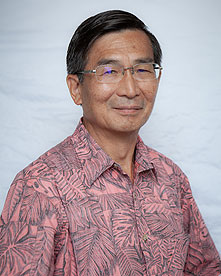
Gary Chock
President
He has been engaged in structural engineering since 1980 and has been responsible for many major private industry projects in Hawaii and Asia, as well as for government agencies. He has been responsible for the Martin Chock & Carden’s strategy of integrating design with structural cost monitoring and value engineering. Under his leadership, Martin Chock & Carden has established multi-faceted expertise in the fields of structural engineering and blast analysis, engineering research and development, planning for natural, man-made, and technological hazards, structural performance reliability analysis, risk analysis, as well as geospatial analysis using Geographic Information Systems. In addition to the structural design of numerous buildings and infrastructure, his project portfolio also includes tsunami, earthquake, and hurricane hazard research, building risk assessments, hazard mitigation planning, coastal flooding hazard analysis, building code development, hurricane shelter evaluations, and emergency response planning.
Mr. Chock has actively led the efforts in modernizing Hawaii’s hurricane wind criteria ; he completed comprehensive wind studies for new wind design mapping that were adopted in the building codes for the entire state. Mr. Chock was the chairman of the State Civil Defense Hurricane Shelter Standards Committee organized to develop public shelter criteria required by the Disaster Emergency Preparedness Act of 2005. Gary Chock authored the Multi-Hazard Pre-Disaster Mitigation Plan for the City & County of Honolulu.
Mr. Chock is an approved data custodian under a DD 2345 Militarily Critical Data Agreement, and he performs Blast Effect Analysis and ATFP using methodologies of the US Army Corps of Engineers Protective Design Center, in accordance with the Unified Facilities Criteria (UFC) Design Procedures, MIL-HDBK-1190 Facility Planning and Design Guide, and UFC 4-010-01 Dod Minimum Anti-terrorism Standards for Buildings. He also works with General Services Administration blast resistant criteria based on The Risk Management Process for Federal Facilities: An Interagency Security Committee Standard (2016).
AWARDS:
In 2010, he was awarded the ASCE Hawaii Chapter Outstanding Civil Engineering Achievement for Windspeed Mapping for the State of Hawaii Incorporating Topographic Effects. The Hawaii State Building Code includes the wind speed mapping he developed, and is now nationally recognized in the ASCE 7 Standard, Minimum Design Loads and Associated Criteria for Buildings and Other Structures.
In 2013, Gary Chock was selected by Engineering News Record as one of the 25 Top Newsmakers of 2012 for his work on developing a national standard for tsunami-resistant design and for leading the ASCE reconnaissance of the March 11, 2011 Tohoku Tsunami.
In 2014, he was bestowed the Western States Seismic Policy Council Lifetime Achievement Award, reflecting a multiple-decades long history of dedicated public service to the State of Hawaii in the areas of earthquake and tsunami mitigation.
In 2015, Gary Chock was selected by the Hawaii Society of Professional Engineers as the Engineer of the Year. He was nominated by the Hawaii Section of the American Society of Civil Engineers for his significant contributions to advancing the engineering state-of-the-art in Hawaii and nationally, particularly for improved codes and standards for earthquakes, high wind and hurricanes, and tsunamis.
In 2015, Gary Chock was selected by the American Society of Civil Engineers Structural Engineering Institute to receive the Walter P. Moore Award for demonstrated technical expertise in and dedication to the development of structural codes and standards.
In 2016, Gary Chock was named a Distinguished Member of the American Society of Civil Engineers, which is its highest honor.
In 2019, the paper, Tsunami Resilient Building Design Considerations for Coastal Communities of Washington, Oregon, and California, received the 2018 Best Paper Award in the Hazards Category from the ASCE Journal of Structural Engineering. It provided guidance on implementing the ASCE 7-16 tsunami design provisions by state and local jurisdictions on the west coast, connecting the technical considerations of structural engineering with community resilience objectives and land use zoning coordination.
EDUCATION: Master of Science in Civil Engineering, Stanford University, 1980
Bachelor of Science in Civil Engineering, University of Hawaii, 1978
PROFESSIONAL REGISTRATION:
Structural Engineer/Hawaii, 1985
Structural Engineer/California, 1986
PROFESSIONAL AFFILIATIONS:
- American Society of Civil Engineers/Structural Engineering Institute: Minimum Design Loads and Associated Criteria for Buildings and Other Structures:
-
- ASCE 7 Steering Committee
- ASCE 7 Main Committee,
- ASCE 7 Tsunami Loads and Effects Subcommittee Chair
- ASCE-7 Subcommittee on Wind Loads
- ASCE 7 Load Combinations Subcommittee
- Structural Engineering Institute Fellow, ASCE
- Distinguished Member, ASCE
- Diplomate, Coastal Engineer, Academy of Coastal, Ocean, Port and Navigation Engineers, ASCE
- American Association for Wind Engineering
- Earthquake Engineering Research Institute
- Hawaii Earthquake and Tsunami Advisory Committee, State Department of Defense 1990-present
- Structural Engineers Association of Hawaii, (2007 Past-President)
PUBLICATIONS:
Chock, G., Carden, L., Robertson, I.N., Wei, Y., Wilson, R., Hooper, J. ,Tsunami Resilient Building Design Considerations for Coastal Communities of Washington, Oregon, and California, Journal of Structural Engineering, Vol. 144, Issue 8, doi: 10.1061/(ASCE)ST.1943-541X.0002068, 2018.
Chock, G., Building Code Amendments to Reduce Existing and Future Building Stock Vulnerability to Coastal Hazards and Climate Impacts in the City and County of Honolulu, Hawaii, State of Hawaii Department of Economic Development and Tourism, Office of Planning, October 31, 2018.
Chock, G., Design for Tsunami Loads and Effects in the ASCE 7-16 Standard. Journal of Structural Engineering, ASCE. 10.1061/(ASCE)ST.1943-541X.0001565 , 04016093, 2016.
Chock, G., Yu, G., Thio, H.K., Lynett, P., Target Structural Reliability Analysis for Tsunami Hydrodynamic Loads of the ASCE 7 Standard. Journal of Structural Engineering, ASCE. 10.1061/(ASCE)ST.1943-541X.0001499 , 04016092, 2016.
Chock, G., Carden, L., Robertson, I., Olsen, M., and Yu, G., Tohoku Tsunami-Induced Building Failure Analysis with Implications for U.S. Tsunami and Seismic Design Codes, Earthquake Spectra 29, Number S1, S99-S126, 2013.
Chock, G., Robertson , I., Kriebel, D., Francis, M., Nistor, I., Tohoku Japan Tsunami of March 11, 2011 – Performance of Structures under Tsunami Loads, American Society of Civil Engineers, Structural Engineering Institute, pp. 350, 2013.
Chock, G., Guide to the Wind Design Provisions of the Hawaii State Building Code, International Code Council and the State of Hawaii Department of Economic Development and Tourism, Office of Planning, 2013.
Chock, G., et al, Compilation of Observations of the October 15, 2006 Kiholo Bay (Mw 6.7) and Mahukona (Mw 6.0) Earthquakes, Hawaii, Earthquake Engineering Research Institute Report, December 31, 2006.
Chock, G., Peterka, J., and Yu, G., Topographic Wind Speed-up and Directionality Factors for Use in the City and County of Honolulu Building Code, 10th Americas Conference on Wind Engineering, 2005.
Chock, G. and Cochran, L., Modeling of Topographic Wind Effects in Hawaii, Journal of Wind Engineering and Industrial Aerodynamics, August, 2005.
Chock, G., Modeling of Hurricane Damage for Hawaii Residential Construction, Journal of Wind Engineering and Industrial Aerodynamics, August, 2005.
NOTABLE BUILDING PLANNING AND DESIGN PROJECTS:
- The Keola La`i Condominium; Honolulu, Hawaii
- The Pinnacle; Honolulu, Hawaii (2006-2008)
- Lanikea at Waikiki Condominium; Honolulu, Hawaii
- Ko`Olina Center and Station; Kapolei, Hawaii
- 2100 Kalakaua Avenue; Honolulu, Hawaii
- First Hawaiian Center; Honolulu, Hawaii
- Hawaii Prince Hotel, Waikiki, Oahu
- Bachelor Enlisted Quarters (MCON P-749 & P-750) Marine Corps Base Hawai‘i, Kāne‘ohe
- USARPAC Command & Control Facility Planning Study; Ft. Shafter; Hawaii
- Keaukaha Military Reservation Joint Military Center, Phase I; Island of Hawaii, Hawaii
- Fleet Store and MWR Outdoor Gear Facility NAVSTA; Pearl Harbor, Hawaii
- Child Development Center NAVSTA; Pearl Harbor, Hawaii
- Honolulu Port Analyses for the Hawaii Tsunami Scenarios
- P-307 Production Services Support Facility, Pearl Harbor
- Joint Base Pearl Harbor Hickam Waterfront Functional Plan
- Guam Apra Harbor Waterfront Facilities Functional Plan
- Yokosuka Naval Complex Waterfront Study
- Seismic Evaluation of 26 Buildings – Diego Garcia
- Hilton Hawaiian Village Pier Structural Repairs, Waikiki, Oahu
- Philippine Consulate Chancery Annex, Honolulu, Hawaii
- PBS Hawaii Broadcast Facility, Honolulu, Hawaii
- University of Hawaii Community Law Outreach Center, Honolulu, Hawaii